Maybe write an explanation of the solution approach here
while (length(cards1) >0&length(cards2) >0) { cyc = cyc +1# top of the hands bet1 = cards1[1] bet2 = cards2[1]# remove the card from the hands# this might prove problematic with only one card# it is problematic! Do a check on lengthif (length(cards1) >1) { cards1 = cards1[2:length(cards1)] } else { cards1 =NULL }if (length(cards2) >1) { cards2 = cards2[2:length(cards2)] } else { cards2 =NULL }# check where they goif (bet1 > bet2) { cards1 =append(cards1, c(bet1, bet2)) } else { cards2 =append(cards2, c(bet2, bet1)) }}
make a function that we can send two hands of cards to # need to create a check on current card and length of remaining hand
if cards are the same as any hand previous, game ends, stop infinite games
need to record each of the hands
win for player one
store_hands <-function(c1, c2, level) {# store in a way that we can compare and retrieve later c1 =paste(c1, collapse ="-") c2 =paste(c2, collapse ="-")# restrict to current round this_level =filter(hands_record, lvl == level)# tibble_row() is nice to keep as one row for rbind rr =tibble_row(c1 = c1, c2 = c2, lvl = level)# check for infinityif (any(c1 == this_level$c1)) { hands_record <<-rbind(hands_record, rr)return(TRUE) }# global variable between subgames hands_record <<-rbind(hands_record, rr)return(FALSE)}
next
# function which we can call recursivelyplay_the_card_game <-function(cards1, cards2) {# how many subgames we have current_level <- global_level# the states for this particular game this_game_record <-c()# loop for as long as we needwhile (length(cards1) >0&length(cards2) >0) {# top cards from each hand bet1 = cards1[1] bet2 = cards2[1]# remove the card from the hands cards1 =tail(cards1, -1) cards2 =tail(cards2, -1)# do we go into a subgameif (bet1 <=length(cards1) & bet2 <=length(cards2)) {# subgame# print('sub') global_level <<- global_level +1# subset by number on the card sub1 = cards1[1:bet1] sub2 = cards2[1:bet2]# recurse result =play_the_card_game(sub1, sub2) winner = result$winner# allocate cards, not necessarily highestif (winner ==1) { cards1 =c(cards1, bet1, bet2) } else { cards2 =c(cards2, bet2, bet1) } } else {# check where they go, regular allocationif (bet1 > bet2) { cards1 =c(cards1, bet1, bet2) } else { cards2 =c(cards2, bet2, bet1) } }# store and check hands score1 =sum(cards1 *rev(seq_along(cards1))) score2 =sum(cards2 *rev(seq_along(cards2))) this_hand =paste(score1, score2, sep ="-")# check for seeing this previouslyif (this_hand %in% this_game_record) {break } else { this_game_record =c(this_game_record, this_hand) } } # print(current_level) game_levels <<-c(game_levels, current_level)# print('finished subgame')if (length(cards1) ==0) { winner =2 } else { winner =1 }# if (global_level == 9) stop()return(list(winner = winner, cards1 = cards1, cards2 = cards2))}
testing
# tester cards# cards1 <- c(9, 2, 6, 3, 1)# cards2 <- c(5, 8, 4, 7, 10)# some set up of thingscards1 <-as.numeric(cards[2:26])cards2 <-as.numeric(cards[29:53])global_level <-1game_levels <-1# infinite = FALSE# hands_record <- tribble(~c1, ~c2, ~lvl)# call the functionsresult <-play_the_card_game(cards1, cards2)# clean up # final_1 <- hands_record$c1[nrow(hands_record)]# final_2 <- hands_record$c2[nrow(hands_record)]# could probably write this out but it's nice to be general# win_cards <- str_split(final_1, "-") %>% unlist()# win_cards <- append(win_cards[2:length(win_cards)], win_cards[1])# win_cards <- append(win_cards, final_2)# this bit is the same as part onescore1 =sum(result$cards1 *rev(seq_along(result$cards1)))
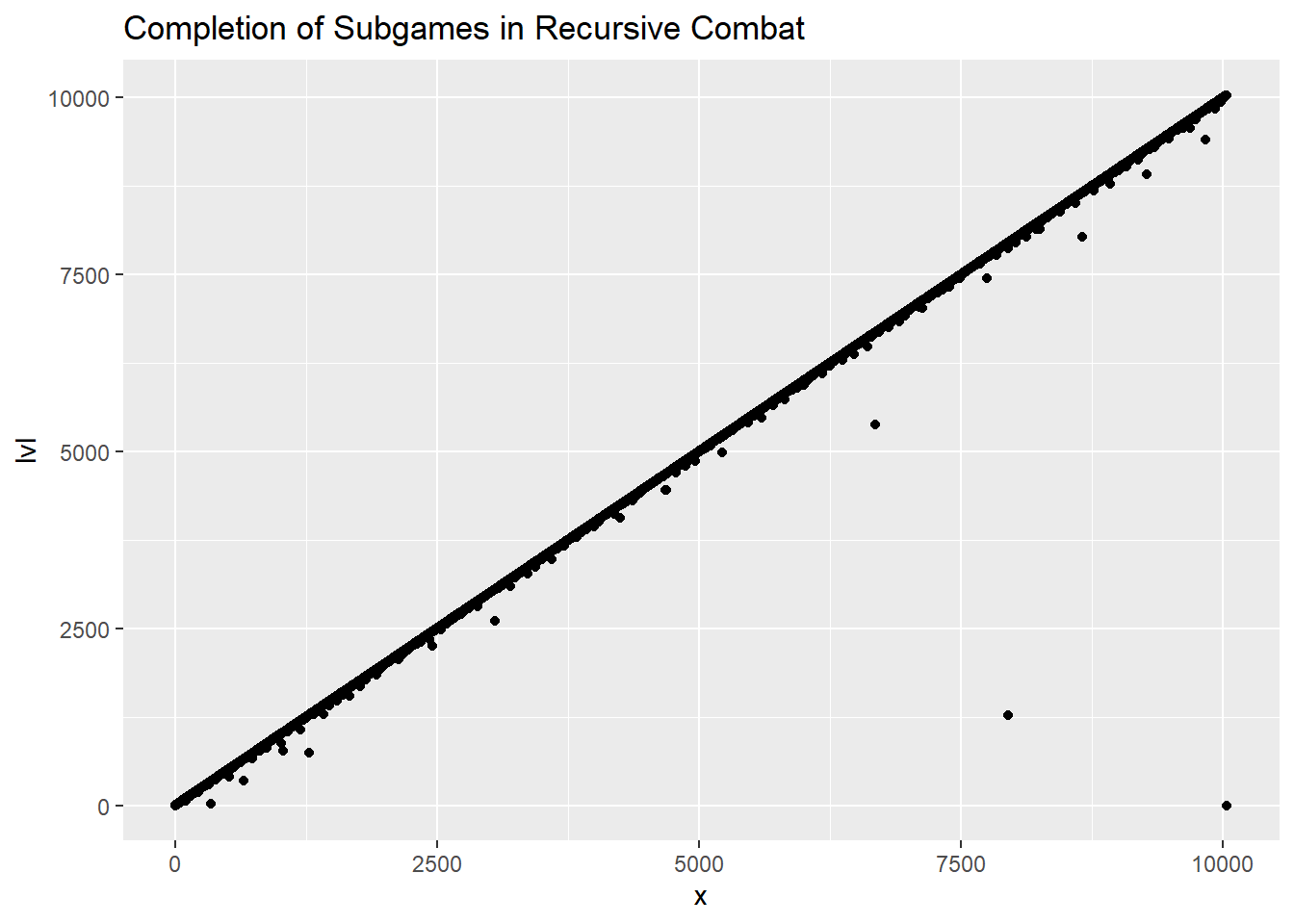
# plot the levelstibble(lvl = game_levels) %>%mutate(x =row_number()) %>%ggplot(aes(x, lvl)) +geom_point() +ggtitle("Completion of Subgames in Recursive Combat")